
Un buscador de norte giroscópico es un dispositivo de medición inercial que utiliza el efecto giroscópico para detectar la velocidad angular de rotación de la Tierra, determinando así de forma autónoma la dirección del norte verdadero. Independientemente de los campos magnéticos externos y de las señales satelitales como el GPS, proporciona una referencia de acimut estable y fiable en condiciones adversas, incluyendo entornos con fuerte interferencia electromagnética, espacios subterráneos y regiones polares. Su principio de funcionamiento básico consiste en utilizar un giroscopio de alta precisión para detectar el vector de velocidad angular de rotación de la Tierra; el ángulo entre el eje de referencia del portador y el norte verdadero se calcula y se emite como información de acimut. Este artículo presenta un análisis comparativo sistemático de los buscadores de norte giroscópicos en cuatro dimensiones: definiciones de precisión, estándares técnicos, escenarios de aplicación y criterios clave de selección.
I. Definiciones de precisión: De las métricas básicas a los sistemas de evaluación integral.
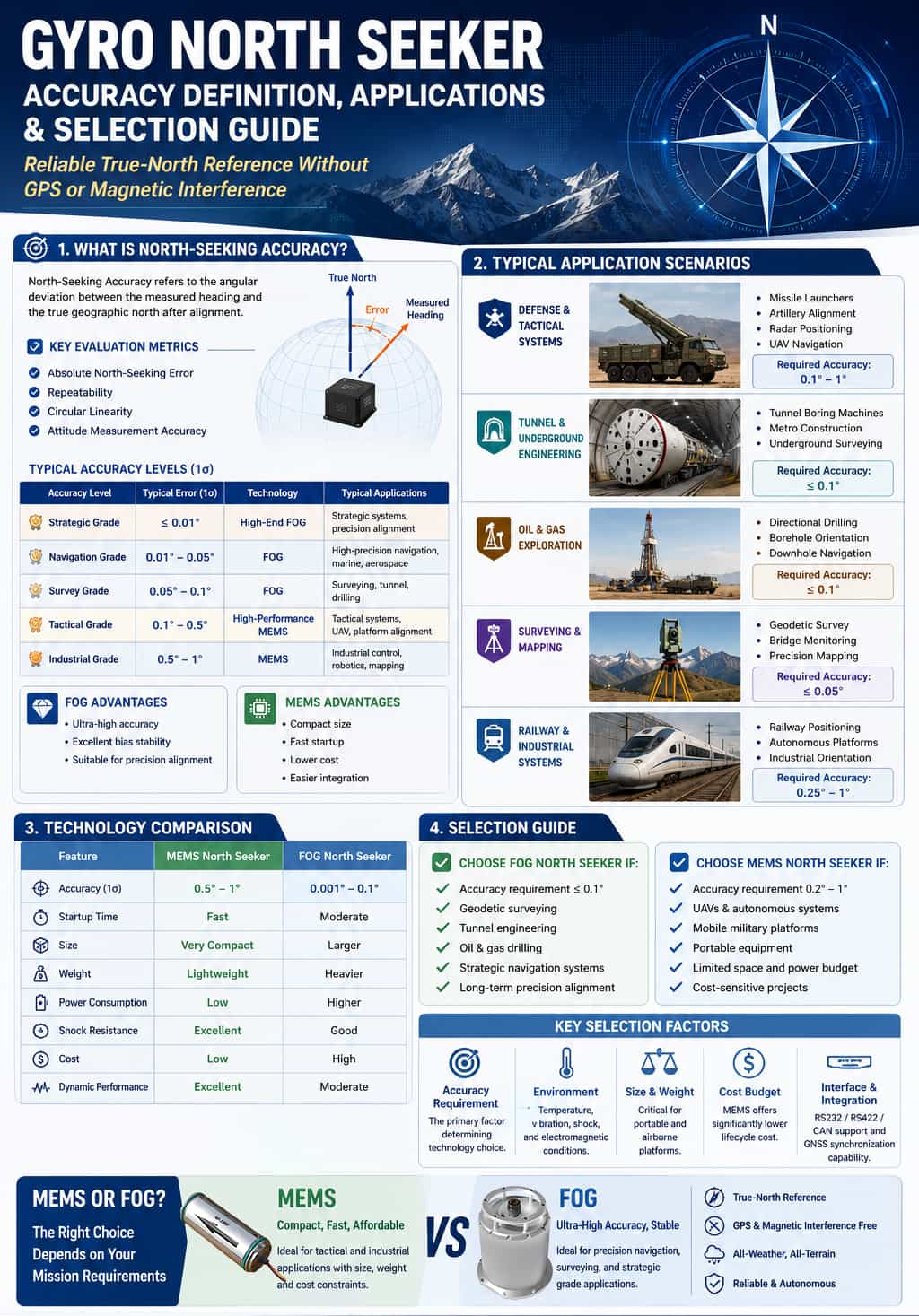
En cuanto a las definiciones de precisión, la precisión de la búsqueda del norte se expresa como una desviación estándar de 1σ, medida en grados o segundos de arco. Una evaluación integral debe abarcar el error absoluto de búsqueda del norte, la repetibilidad, la linealidad circular y el error de medición de la actitud. Los buscadores de norte de fibra óptica pueden alcanzar niveles de precisión estática de 0,02° o incluso 0,001°; aprovechando el efecto Sagnac y el control de bucle cerrado totalmente digital, su inestabilidad de sesgo puede ser tan baja como 0,002°/h. El rendimiento de los buscadores de norte MEMS ha mejorado significativamente en los últimos años; los productos de gama alta han logrado una inestabilidad de sesgo mejor que 0,02°/h, con una precisión típica de búsqueda del norte que oscila entre 0,5° y 1° (por ejemplo, el Maixinminwei NF1100 alcanza ≤1°×seg(L), mientras que el NF1200 alcanza 0,5°×seg(L)), y algunos productos en miniatura pueden lograr una precisión de 0,25° en tres minutos. Las soluciones de fibra óptica destacan por su precisión absoluta, mientras que las soluciones MEMS ofrecen ventajas en cuanto a tamaño y coste.
II. Normas técnicas: Un sistema multinivel que abarca desde las especificaciones militares hasta las normas nacionales.
El sistema de estándares técnicos para buscadores de norte giroscópicos abarca múltiples niveles, incluyendo estándares militares nacionales, estándares industriales y estándares nacionales, proporcionando un marco integral para el diseño, la fabricación, las pruebas y la aceptación del producto. Tanto los buscadores de norte giroscópicos de fibra óptica como los MEMS deben cumplir con los requisitos de este sistema de estándares; el cumplimiento es particularmente riguroso en el sector militar, donde los estándares pertinentes tienen mayor fuerza obligatoria. A nivel de estándares militares nacionales, la norma GJB 2863A-2015, *Especificación general para buscadores de norte giroscópicos*, sirve como documento guía. Esta norma estipula requisitos generales, requisitos detallados y disposiciones de garantía de calidad, constituyendo la base fundamental para el desarrollo y la producción de todos los buscadores de norte giroscópicos de grado militar.
A nivel de norma nacional, la norma GB/T 45570-2025, *Requisitos técnicos generales para giroscopios ópticos*, es la más reciente. Abarca la clasificación de productos, los requisitos técnicos, los métodos de ensayo y las especificaciones de marcado y embalaje de giroscopios de fibra óptica y giroscopios láser. Su apéndice B proporciona datos de referencia sobre indicadores clave de rendimiento para productos típicos de giroscopios de fibra óptica, constituyendo una base técnica fundamental para el diseño, la producción y la aceptación de estos dispositivos. Además, algunas empresas gestionan la producción de acuerdo con normas de sistemas de calidad como la ISO 9001:2008.
A nivel de componente de giroscopio, la norma GJB 10024-2021, *Métodos de prueba para giroscopios MEMS*, especifica las condiciones, los elementos y los métodos de prueba para giroscopios MEMS; se aplica a las pruebas funcionales y de rendimiento de giroscopios MEMS utilizados en sistemas de navegación inercial, guiado y control. La norma GJB 8898-2017, *Especificación general para giroscopios de fibra óptica*, estandariza específicamente los requisitos de rendimiento y los métodos de prueba para giroscopios de fibra óptica.
III. Escenarios de aplicación: Aplicaciones multidisciplinares que abarcan desde el frente de batalla hasta la ingeniería subterránea.
Los buscadores de norte giroscópicos se utilizan tanto en el sector militar como en el civil, abarcando una amplia gama de condiciones operativas, desde la referenciación estática de alta precisión hasta la orientación dinámica en tiempo real. Debido a las diferencias en sus características de rendimiento y diseño estructural, los buscadores de norte giroscópicos MEMS y los de fibra óptica tienen escenarios de aplicación distintos.
En el sector militar, los buscadores de norte giroscópicos son equipos esenciales para la orientación rápida y encubierta de sistemas de armas. Gracias a su precisión estática de nivel de segundo de arco, los buscadores de norte de fibra óptica se utilizan ampliamente para tareas de alineación de alta precisión en artillería, lanzadores de misiles, antenas de radar y sistemas de navegación inercial naval. Aprovechando ventajas como su tamaño compacto, bajo consumo de energía y rápido arranque, los instrumentos MEMS de búsqueda de norte están experimentando un aumento significativo en su aplicación en plataformas de armas ligeras. Facilitan la alineación rápida previa al lanzamiento de misiles, cohetes, artillería y vehículos aéreos no tripulados (UAV), e incluso pueden integrarse en terminales portátiles para soldados, vehículos submarinos y plataformas de munición guiada, escenarios donde las soluciones de fibra óptica son difíciles de implementar. En entornos caracterizados por interferencias electromagnéticas o la anulación de la señal GPS, la naturaleza totalmente autónoma y resistente a las interferencias de los instrumentos MEMS de búsqueda de norte los convierte en una herramienta ideal para la orientación encubierta en sistemas de armas móviles.
En el sector civil, los instrumentos de búsqueda del norte de fibra óptica se utilizan principalmente para el control direccional en la tunelización con escudo, proporcionando una referencia estable del norte verdadero en las profundidades de los túneles donde no hay señales GPS. En la exploración de petróleo y gas, se instalan cerca de la broca para medir el acimut y la inclinación del pozo en tiempo real; como tecnología clave para la perforación direccional, alcanzan una precisión de aproximadamente ±0,1°. En geodesia e ingeniería de precisión, estos instrumentos proporcionan referencias de acimut de alta precisión para estaciones totales y rastreadores láser, y se utilizan para el monitoreo de deformaciones de estructuras como puentes y presas, alcanzando una precisión estática de ≤0,02°. Gracias a su rentabilidad, miniaturización y bajo consumo de energía, los instrumentos de búsqueda del norte MEMS proporcionan un control fiable de orientación y actitud en entornos sin GPS ni magnetómetro, como la tunelización de minas de carbón y las operaciones mineras en general; además, los sistemas MEMS integrados pueden alcanzar una precisión de rumbo de 0,25° en trenes. En general, la tecnología MEMS permite la creación de instrumentos más pequeños y ligeros orientados hacia el norte que satisfacen las necesidades de la mayoría de las industrias de la construcción con una precisión de nivel medio a alto, lo que los hace especialmente adecuados para campos con entornos de topografía limitados.
En cuanto a la adaptabilidad ambiental, los instrumentos de búsqueda del norte basados en fibra óptica son sensibles a las fluctuaciones de temperatura y voluminosos, lo que requiere compensación de deriva cuando existen gradientes de temperatura significativos bajo tierra. Por el contrario, los instrumentos de búsqueda del norte basados en MEMS ofrecen resistencia a vibraciones y golpes, así como capacidades de integración compacta, aunque su tolerancia a altas temperaturas se limita a aproximadamente 85 °C. En consecuencia, las soluciones de fibra óptica presentan ventaja en escenarios que implican perforación continua a altas temperaturas en pozos. IV. Consideraciones clave para la selección: Un análisis exhaustivo de las ventajas y desventajas
A la hora de elegir entre instrumentos MEMS e instrumentos de fibra óptica para la búsqueda del norte, hay que sopesar múltiples factores, como los requisitos de precisión, los entornos operativos, las características dinámicas, el tamaño y el peso, los presupuestos y las capacidades de integración, ya que las prioridades varían significativamente según el escenario de aplicación.
Los requisitos de precisión determinan la elección de la tecnología: para aplicaciones de alta precisión que requieren una exactitud de ≤0,1°, como la alineación de sistemas de navegación inercial a bordo de buques o el establecimiento de puntos de referencia geodésicos de alta precisión, los instrumentos de búsqueda del norte de fibra óptica suelen ser la única opción, ofreciendo una exactitud estática de 0,02° o incluso 0,001°. Por el contrario, si la exactitud requerida se encuentra entre 0,2° y 1,0° y el coste es un factor importante, los MEMS son la mejor opción; algunos productos MEMS ofrecen una alineación rápida en 30 segundos (exactitud de 1°) o una alineación precisa en 90 segundos (exactitud de 0,5°), lo que demuestra claras ventajas en la respuesta dinámica.
El tamaño, el peso y el consumo de energía son factores cada vez más críticos en las aplicaciones modernas. Los instrumentos MEMS de búsqueda del norte se pueden miniaturizar hasta alcanzar cubos de aproximadamente 40 mm, con un peso inferior a 70 g y un consumo de energía de tan solo 1,5 W, lo que los hace ideales para plataformas sensibles a la carga útil, como el equipo individual del soldado. Los instrumentos tradicionales de fibra óptica son significativamente más grandes y consumen más energía; a pesar de las optimizaciones recientes, aún se quedan muy por detrás de los MEMS en estos aspectos, lo que convierte a los MEMS en prácticamente la única tecnología viable para aplicaciones con limitaciones de espacio.
· La adaptabilidad ambiental es otro factor clave en la selección. Los instrumentos MEMS de búsqueda del norte ofrecen una resistencia superior a las vibraciones y los golpes, lo que los hace adecuados para plataformas dinámicas como vehículos y aeronaves; ninguna de las dos tecnologías es susceptible a la interferencia de campos magnéticos. Las soluciones de fibra óptica presentan ventajas en entornos de alta temperatura (al carecer de las limitaciones de temperatura de los semiconductores), lo que las hace especialmente adecuadas para la perforación continua en pozos a altas temperaturas. Si bien los dispositivos MEMS tienen una tolerancia a altas temperaturas ligeramente menor, ambas tecnologías generalmente cubren un rango de temperatura de funcionamiento de -40 °C a +80 °C.
· La estructura mecánica y los mecanismos de indexación también influyen directamente en la decisión de selección. Los instrumentos de búsqueda del norte de fibra óptica utilizan un giroscopio de un solo eje combinado con un mecanismo de indexación mecánico; si bien ofrecen una alta precisión estática, su rendimiento dinámico es limitado y son propensos a la deriva bajo vibración. En contraste, los instrumentos de búsqueda del norte MEMS suelen emplear una configuración de tres ejes con anclaje fijo que elimina la necesidad de mecanismos de indexación, lo que resulta en una respuesta dinámica y resistencia a la vibración superiores; además, algunos modelos MEMS de un solo eje de bajo costo logran reducciones de costos manteniendo la precisión mediante técnicas de modulación rotacional.
· Durante el proceso de selección, es crucial considerar los costos. Los instrumentos de búsqueda del norte basados en fibra óptica implican altos costos iniciales de adquisición, alcanzando los cientos de miles de yuanes en los modelos de gama alta. Por el contrario, los instrumentos MEMS se benefician de los procesos de producción en masa de semiconductores, lo que ofrece costos significativamente menores para una precisión equivalente. Si los requisitos de precisión no son demasiado estrictos y el costo es la principal limitación, la tecnología MEMS ofrece una clara ventaja económica. Ambas tecnologías presentan diseños de estado sólido con costos de mantenimiento manejables; sin embargo, los dispositivos MEMS ofrecen mayores niveles de integración y, por lo general, presentan menores tasas de falla.
· Las capacidades de integración y las interfaces de comunicación representan detalles técnicos clave en el proceso de selección. Los instrumentos giroscópicos convencionales para la búsqueda del norte admiten interfaces seriales como RS422, RS232 y CAN, con frecuencias de salida de datos que suelen oscilar entre 100 Hz y 200 Hz; los usuarios deben asegurarse de la compatibilidad con los tipos de interfaz y los requisitos del protocolo de datos de su sistema anfitrión. En cuanto a la integración GNSS, algunos productos de gama alta ofrecen funciones de entrada de sincronización PPS y salida TOV, lo que permite la sincronización horaria entre los datos inerciales y los receptores satelitales externos.
La selección de un giroscopio para la orientación al norte es un proceso sistemático que implica considerar la precisión, el costo, el entorno operativo, las características dinámicas y la integración. Las tecnologías MEMS y de fibra óptica presentan ventajas y limitaciones operativas distintas; ninguna es intrínsecamente superior a la otra. Los usuarios deben realizar una evaluación exhaustiva de los requisitos de su misión para lograr un equilibrio óptimo entre ambos enfoques: para aplicaciones estratégicas que priorizan la máxima precisión sin importar el costo, los giroscopios de fibra óptica siguen siendo la opción insustituible; para escenarios tácticos y civiles que priorizan la miniaturización, la respuesta rápida y la rentabilidad, los giroscopios MEMS ofrecen una solución más pragmática y flexible. A medida que la precisión de los giroscopios MEMS continúa mejorando y la tecnología de miniaturización de los giroscopios de fibra óptica avanza, los límites entre estas dos tecnologías se difuminan cada vez más. Es probable que las futuras decisiones de selección se centren más en las limitaciones específicas del escenario de la misión que en las etiquetas tecnológicas únicamente, un cambio que sin duda brindará a los usuarios finales una gama más amplia de opciones y una mejor relación costo-rendimiento.
dejar un mensaje
Escanea y envíalo a WeChat. :