
Los enfoques técnicos actuales para los sistemas de navegación inercial se dividen en dos categorías: navegación inercial basada en MEMS (que utiliza sistemas microelectromecánicos) y navegación inercial por fibra óptica (basada en principios de interferencia óptica). Estas dos tecnologías difieren fundamentalmente en sus principios físicos, métricas de rendimiento, estructuras de costos y escenarios de aplicación. Este artículo ofrece una comparación integral y multidimensional de estas tecnologías para ayudar a los ingenieros a tomar decisiones informadas durante el proceso de selección.
I. Diferencias fundamentales en los principios de funcionamiento
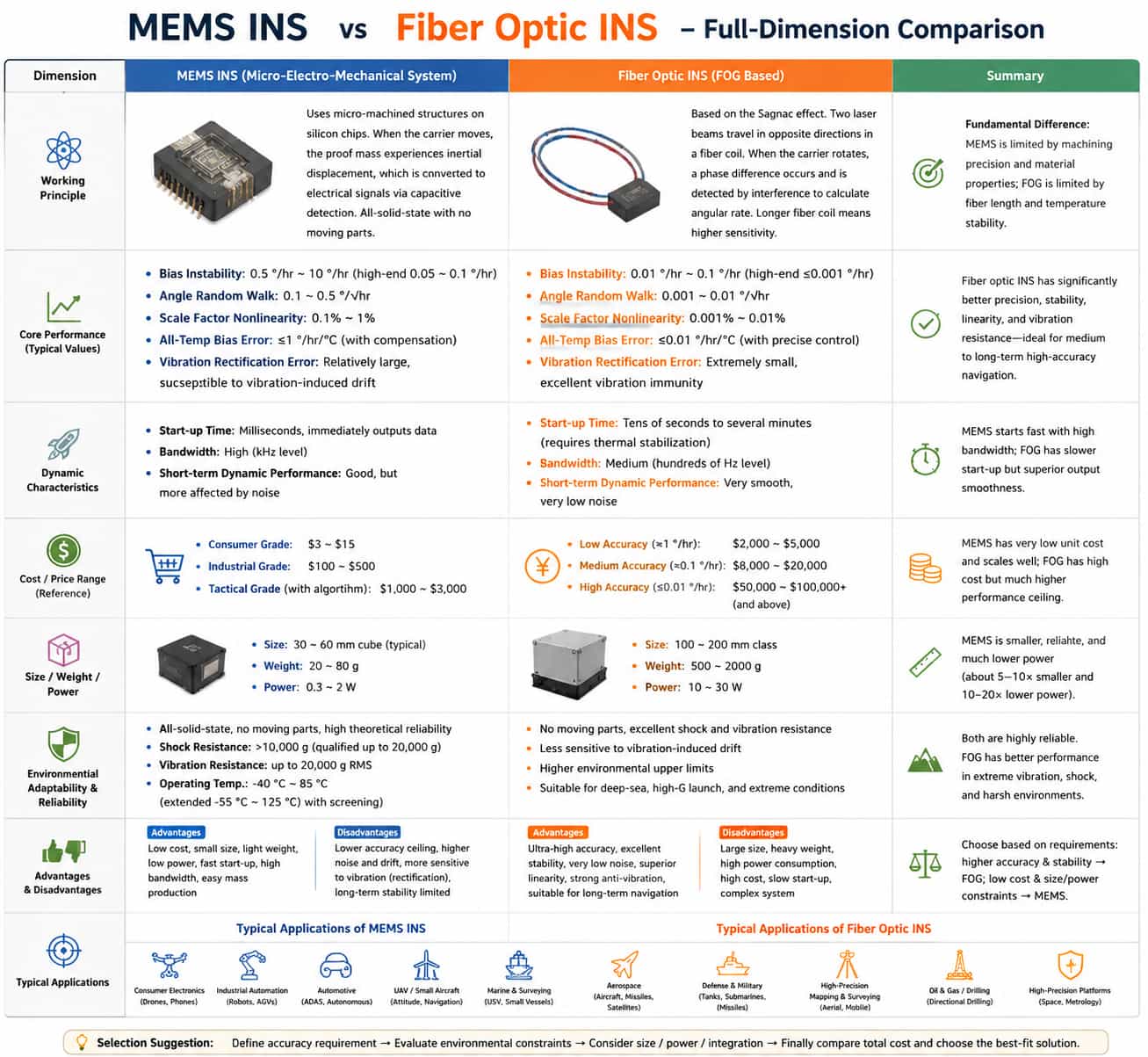
Los sistemas de navegación inercial MEMS emplean tecnología de micromecanizado de silicio para fabricar micromasas móviles en un chip. Cuando el portador se mueve, las fuerzas inerciales provocan el desplazamiento de estas masas, generando señales eléctricas mediante cambios de capacitancia: un diseño completamente de estado sólido sin partes giratorias. Los sistemas de navegación inercial de fibra óptica se basan en el efecto Sagnac, donde un haz láser se divide en dos haces que se propagan en direcciones opuestas dentro de una bobina de fibra óptica. La rotación del portador crea una diferencia de trayectoria óptica entre los haces, y la velocidad angular se calcula mediante la detección de interferencias. La sensibilidad aumenta con la longitud de la bobina de fibra.
Estas diferencias de principio determinan las características inherentes de cada tecnología: los sistemas MEMS funcionan como sensores de "masa de estado sólido", insensibles a las vibraciones pero limitados por la precisión de fabricación, mientras que los sistemas de fibra óptica actúan como "interferómetros ópticos", capaces de alta precisión pero significativamente influenciados por la longitud de la fibra y la temperatura.
II. Comparación de los parámetros de rendimiento principales
La estabilidad del sesgo es la métrica principal para medir la precisión de la navegación inercial. Los valores típicos para la navegación inercial MEMS oscilan entre 0,5°/h y 10°/h; si bien los productos tácticos de alta gama pueden alcanzar entre 0,05°/h y 0,1°/h, se acercan al límite de precisión de la tecnología. En contraste, los sistemas de navegación inercial de fibra óptica suelen presentar una estabilidad del sesgo entre 0,01°/h y 0,1°/h, y los productos de alta gama alcanzan los 0,001°/h (nivel de segundo de arco). Los sistemas de fibra óptica demuestran una clara ventaja en escenarios que requieren navegación inercial pura durante periodos que van desde varios minutos hasta decenas de minutos.
La variación aleatoria del ángulo refleja el impacto del ruido blanco en la integración de la actitud. Los valores típicos para la navegación inercial MEMS oscilan entre 0,1°/√h y 0,5°/√h, mientras que los sistemas de fibra óptica pueden alcanzar valores tan bajos como 0,001°/√h a 0,01°/√h. Esto significa que, durante maniobras dinámicas a corto plazo, la información de actitud de los sistemas de navegación inercial de fibra óptica es más suave y presenta menos fluctuaciones.
No linealidad del factor de escala: En los sistemas de navegación inercial MEMS, esta suele oscilar entre el 0,1 % y el 1 %, mientras que los sistemas de fibra óptica pueden alcanzar valores entre el 0,001 % y el 0,01 %. Esta ventaja de no linealidad es crucial para maniobras de alta dinámica (como las que realizan los misiles o los aviones de combate).
Error de polarización de temperatura total: Los materiales de silicio MEMS tienen coeficientes de temperatura elevados; sin compensación, la deriva térmica de los sistemas inerciales MEMS puede alcanzar decenas o incluso superar los cien °/h/°C. Los productos MEMS modernos de alta gama utilizan compensación de temperatura integrada y ajuste polinómico para reducir la deriva térmica a menos de 1 °/h/°C. Los sistemas de fibra óptica también son sensibles a la temperatura, pero el coeficiente de temperatura de la propia bobina de fibra se puede mitigar parcialmente mediante técnicas de bobinado simétrico; combinado con un control preciso de la temperatura, el error de temperatura total se puede mantener por debajo de 0,01 °/h/°C.
Error de rectificación de vibraciones: Los sistemas inerciales MEMS son propensos a la deriva de CC bajo vibraciones intensas y de alta frecuencia, un defecto inherente. Los sistemas de fibra óptica, al carecer de masas de prueba móviles, presentan una excelente resistencia a las vibraciones, manteniendo una precisión mucho mayor que los sistemas MEMS en entornos vibratorios.
Tiempo de arranque y características de respuesta: Los sistemas inerciales MEMS generan datos inmediatamente después de encenderse, con tiempos de arranque del orden de los milisegundos. Los sistemas de fibra óptica requieren un período de calentamiento y estabilización (que suele oscilar entre decenas de segundos y varios minutos) porque la fuente de luz y la bobina de fibra deben alcanzar el equilibrio térmico; de lo contrario, se produce una deriva significativa del punto cero.
III. Estructura de costos y rango de precios
Los sistemas inerciales MEMS se benefician de los procesos de fabricación de semiconductores a gran escala, lo que resulta en costos unitarios muy bajos. Los precios oscilan entre 3 y 15 dólares para chips IMU MEMS de consumo, entre 100 y 500 dólares para módulos de grado industrial (con compensación de temperatura y calibración) y aproximadamente entre 1000 y 3000 dólares para sistemas inerciales MEMS de grado táctico (incluidos algoritmos).
El coste de los sistemas inerciales de fibra óptica depende principalmente de la bobina de fibra, los procesos de bobinado de precisión, la fuente de luz (SLD) y el fotodetector. Las bobinas de fibra requieren un bobinado de alta precisión, lo que implica elevados costes de mano de obra y equipos, y, a diferencia de los chips, no pueden beneficiarse de las mismas economías de escala para reducir los precios. Los módulos giroscópicos de fibra óptica (FOG) de baja precisión (estabilidad de polarización en el rango de 1°/h) tienen un precio aproximado de entre 2000 y 5000 dólares; las unidades de precisión media (rango de 0,1°/h) cuestan entre 8000 y 20 000 dólares; y las unidades de alta precisión (rango de 0,01°/h o superior) pueden superar los 50 000-100 000 dólares.
En lo que respecta a la estructura de costes, los dispositivos MEMS tienen costes marginales extremadamente bajos, lo que los hace adecuados para su despliegue masivo; por el contrario, los sistemas de navegación inercial (INS) de fibra óptica tienen costes unitarios elevados, aunque su rendimiento máximo supera con creces el de los MEMS.
IV. Tamaño, peso y consumo de energía
Las unidades INS MEMS industriales de alta precisión suelen presentar un diseño modular en miniatura, con dimensiones de tan solo 30 a 60 mm por lado. Su estructura compacta, libre de componentes ópticos redundantes, permite su integración directa en plataformas de turbinas eólicas o equipos anfitriones pequeños, con un mínimo espacio de instalación. En cambio, las unidades INS de fibra óptica incorporan bobinas de fibra, fuentes láser, circuitos de demodulación óptica y estructuras de control térmico; por consiguiente, suelen medir entre 100 y 200 mm, ocupan entre 5 y 10 veces el volumen de las unidades MEMS, requieren un espacio de instalación considerable y no son adecuadas para su integración en equipos compactos.
Las unidades INS MEMS utilizan tecnología MEMS basada en silicio, manteniendo el peso total generalmente entre 20 g y 80 g. Este peso ultraligero no impone carga adicional a las plataformas flotantes marinas ni a las estructuras de montaje ligeras, lo que las hace ideales para instalaciones ligeras y un montaje sin tensiones. Sin embargo, las unidades INS de fibra óptica presentan estructuras ópticas complejas, carcasas metálicas pesadas y componentes de aislamiento térmico, lo que resulta en un peso total de 500 a 2000 g. Este peso considerable limita su uso a plataformas fijas y pesadas, y las hace inadecuadas para escenarios de monitoreo que requieren diseños ligeros o estrictas restricciones de carga. Los sistemas de navegación inercial MEMS funcionan con circuitos basados en chips y operan con un consumo de energía extremadamente bajo, típicamente de solo 0,3 a 2 W en estado estacionario. Admiten un funcionamiento prolongado con batería y un monitoreo continuo (24/7) de bajo consumo, lo que las hace ideales para equipos ligeros desplegados en entornos de campo remotos o en mar abierto que carecen de un suministro de energía continuo. En cambio, los sistemas de navegación inercial por fibra óptica requieren alimentación continua para la fuente láser, la demodulación de la señal óptica y los módulos de control de temperatura. Su consumo de energía básico suele oscilar entre 10 y 30 W —decenas de veces superior al de los sistemas MEMS— y requieren estructuras auxiliares de disipación de calor, lo que limita su uso a plataformas de ingeniería fijas con alimentación eléctrica estable y suficiente capacidad de potencia.
V. Adaptabilidad y fiabilidad ambiental
Los sistemas de navegación inercial MEMS son dispositivos de estado sólido sin partes móviles, lo que les confiere una alta fiabilidad teórica. Sin embargo, en condiciones de impacto elevado (>10 000 g) y vibraciones intensas, la masa de prueba de silicio puede adherirse o fracturarse. Las unidades MEMS de grado militar, con un encapsulado especializado, pueden soportar impactos de hasta 20 000 g. Su rango de temperatura de funcionamiento estándar es de -40 °C a 85 °C, que puede ampliarse de -55 °C a 125 °C mediante pruebas de estanqueidad.
Los sistemas de navegación inercial de fibra óptica carecen de partes móviles; dado que la bobina de fibra óptica está compuesta esencialmente de fibra de vidrio, ofrece una resistencia superior a los golpes y vibraciones en comparación con los MEMS. Sin embargo, la bobina es sensible a la flexión y la tensión, y un embalaje inadecuado puede provocar una mayor pérdida óptica. Los sistemas de fibra óptica ofrecen un mayor margen de adaptabilidad ambiental, lo que los hace idóneos para condiciones extremas como la presión de los submarinos en aguas profundas, el movimiento continuo de los buques y los entornos de lanzamiento con altas fuerzas G.
Resumen de una comparación exhaustiva
Los sistemas de navegación inercial MEMS destacan por su tamaño, peso, consumo de energía, coste y velocidad de arranque, pero presentan limitaciones en cuanto a precisión máxima y resistencia a la deriva inducida por vibraciones. Los sistemas de fibra óptica sobresalen por su altísima precisión, estabilidad a largo plazo y resistencia a las interferencias ambientales, pero son menos competitivos en cuanto a tamaño, consumo de energía, coste y tiempo de arranque. No existe una opción "correcta" o "incorrecta", sino simplemente una cuestión de idoneidad: primero, determine los requisitos de precisión; luego, considere las limitaciones ambientales; y, finalmente, evalúe los factores económicos.
dejar un mensaje
Escanea y envíalo a WeChat. :