
 1. Introducción: Panorama tecnológico y visión general del mercado de los sistemas de navegación inercial.
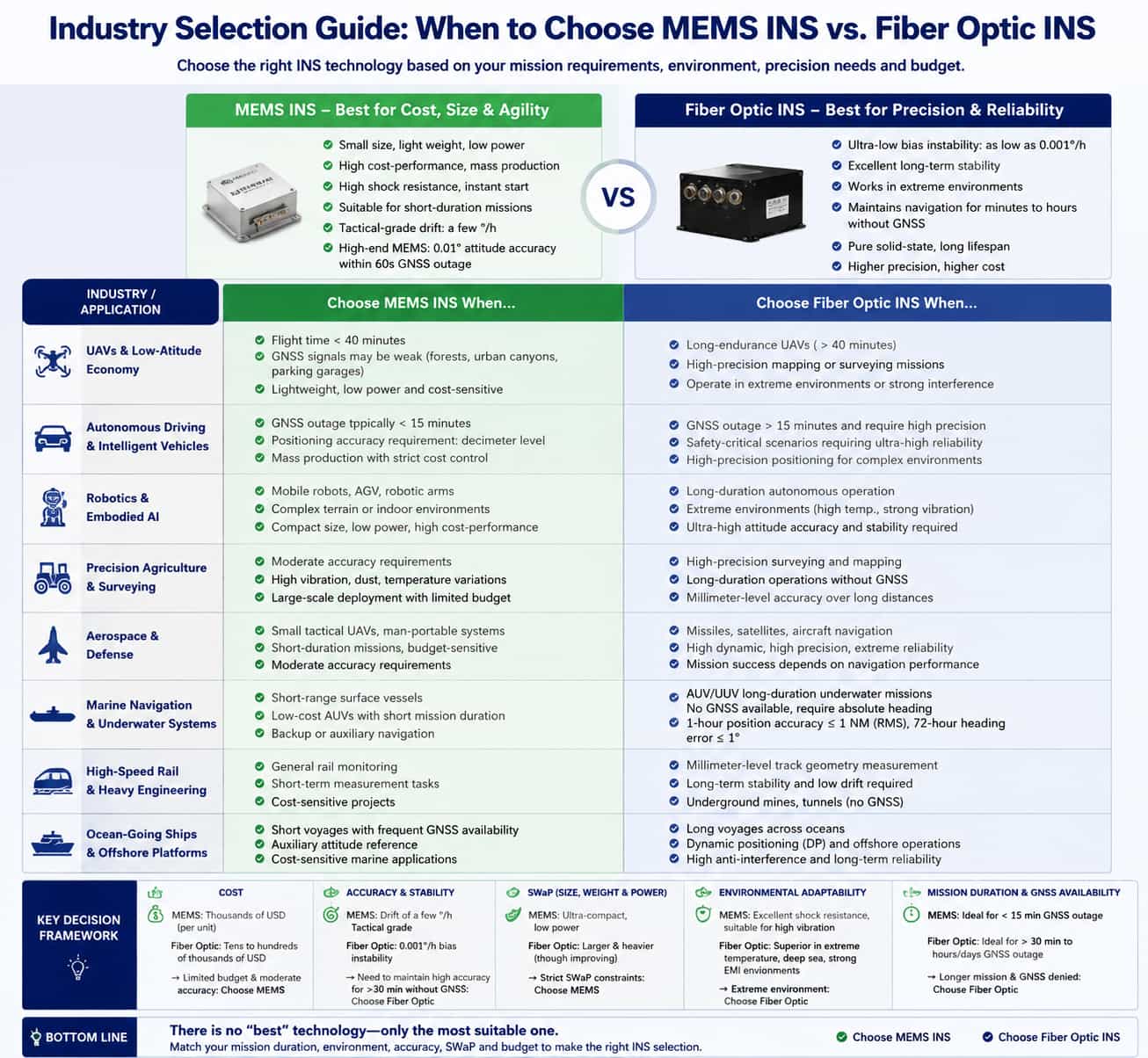
Como tecnología de navegación autónoma que no depende de señales externas, los Sistemas de Navegación Inercial (INS) están experimentando un crecimiento sin precedentes impulsado por el rápido avance de tecnologías de vanguardia como la inteligencia artificial, la conducción autónoma y la industria aeroespacial comercial. En medio de una feroz competencia de mercado y una rápida evolución tecnológica, los Sistemas Microelectromecánicos (MEMS) y los Giroscopios de Fibra Óptica (FOG) se han consolidado como las dos principales vías tecnológicas en el sector INS. Cada uno ofrece ventajas distintas; por consiguiente, seleccionar la tecnología adecuada para escenarios de aplicación específicos se ha convertido en un desafío crucial para ingenieros y equipos de compras. La elección entre MEMS y FOG no se limita a una mera comparación de especificaciones técnicas, sino que requiere una evaluación integral de la duración de la misión, las condiciones ambientales, los umbrales de precisión, las limitaciones de SWaP (tamaño, peso y potencia) y el presupuesto.
2. Comparación de núcleos: INS MEMS frente a INS de fibra óptica
2.1. Principios de funcionamiento y diferencias técnicas
El sistema MEMS INS se basa en estructuras capacitivas o piezorresistivas a microescala para medir el movimiento mediante la detección del desplazamiento mecánico; estos sistemas pueden encapsularse a nivel de chip, lo que permite una producción en masa de bajo coste. En cambio, el sistema INS de fibra óptica utiliza el efecto Sagnac, empleando bobinas de fibra óptica de kilómetros de longitud para detectar la rotación; su diseño totalmente de estado sólido garantiza una larga vida útil y resistencia en entornos extremos. La principal ventaja del sistema INS de fibra óptica es su alta precisión: logra una estabilidad de polarización de tan solo 0,001°/h y mantiene las capacidades de navegación durante decenas de minutos o incluso varias horas tras la pérdida de la señal GNSS. El sistema MEMS INS destaca por su extrema miniaturización, bajo consumo energético, rentabilidad, arranque instantáneo y alta resistencia a los golpes. En los últimos años, la tasa de deriva de los MEMS de grado táctico se ha reducido a unos pocos grados por hora, y los productos de gama alta pueden mantener una precisión de actitud de 0,01° durante una interrupción del GNSS de 60 segundos, reduciendo progresivamente la brecha de rendimiento con los sistemas INS de fibra óptica.
3. Análisis en profundidad de los escenarios de aplicación de los sistemas de navegación inercial MEMS.
3.1. Vehículos aéreos no tripulados y la economía de baja altitud
Los drones de consumo y logística representan escenarios de aplicación clave para los sistemas de navegación inercial MEMS. En entornos con señales GNSS débiles, como bosques, aparcamientos subterráneos y zonas urbanas congestionadas, las IMU MEMS proporcionan a los drones datos de posición y orientación continuos y precisos. Para drones pequeños y medianos con tiempos de vuelo inferiores a 40 minutos, su ligereza y bajo consumo energético se ajustan perfectamente a los requisitos de tamaño, peso y potencia (SWaP); además, han experimentado un crecimiento anual de pedidos superior al 200 % en sectores emergentes como la logística a baja altitud y las inspecciones no tripuladas.
3.2. Conducción autónoma y vehículos inteligentes
La conducción inteligente se ha convertido en el principal motor de crecimiento del mercado de la navegación inercial civil. En aplicaciones prácticas, los vehículos equipados con módulos IMU MEMS pueden lograr un posicionamiento continuo y preciso —con errores inferiores a 8 centímetros— incluso en zonas donde la señal satelital se pierde por completo, como aparcamientos subterráneos de tres niveles, lo que permite un estacionamiento autónomo eficaz. La tecnología INS MEMS satisface los requisitos de precisión de la mayoría de las aplicaciones industriales y de consumo de alta precisión, ofreciendo una exactitud suficiente gracias a un control de costes excepcional.
3.3. Robótica y agentes físicos
A medida que se acelera la comercialización de equipos inteligentes, como robots humanoides, perros robot y vehículos guiados automáticamente (AGV), la demanda de sensores de actitud inerciales ha experimentado un crecimiento estructural, dado su papel fundamental como el "sistema nervioso del equilibrio" y el "cerebelo" de los robots. Cuando los robots atraviesan terrenos complejos, las señales GNSS pueden interrumpirse; los sistemas MEMS INS proporcionan una orientación precisa para garantizar un funcionamiento estable. En la automatización industrial, los sistemas MEMS INS se han convertido en un estándar del sector para tareas que van desde la navegación autónoma de AGV hasta el control de actitud de brazos robóticos industriales, gracias a su tamaño compacto y bajo coste.
3.4. Agricultura de precisión y topografía
Si bien los drones agrícolas y la maquinaria agrícola autónoma tienen requisitos relativamente moderados en cuanto a la precisión de sus sistemas de navegación, exigen una alta resistencia a las vibraciones, las fluctuaciones de temperatura y los contaminantes ambientales. El sistema MEMS INS se ha convertido en la opción principal en la agricultura de precisión debido a su excelente resistencia a los golpes y su rentabilidad. Desde la monitorización de la siembra hasta la fertilización de tasa variable, el sistema MEMS INS proporciona a los equipos agrícolas capacidades de detección de posición estables y fiables; además, su bajo coste unitario, en comparación con las soluciones de fibra óptica, hace factible su implementación comercial a gran escala.
4. Análisis en profundidad de los escenarios de aplicación de los sistemas de navegación inercial (INS) de fibra óptica.
4.1. Equipos aeroespaciales y de defensa
Las aplicaciones de sistemas de navegación inercial (INS) de fibra óptica en los sectores aeroespacial y de defensa representan el estándar de oro. Ya sea para misiles tácticos de alta dinámica, control de actitud de satélites o sistemas de navegación para grandes aviones de transporte y cazas, los giroscopios de fibra óptica (FOG), con su deriva de polarización excepcionalmente baja y su estabilidad superior a largo plazo, siguen siendo componentes esenciales. En el sector aeroespacial, los sistemas de navegación inercial (INS) de fibra óptica operan independientemente de fuentes de radiación externas y no se ven afectados por la geografía, el clima ni los entornos adversos; su ámbito operativo abarca el espacio aéreo, la superficie terrestre, el subsuelo, los océanos abiertos e incluso las profundidades marinas. Por ejemplo, los sistemas de navegación y control para plataformas de alta dinámica basados en tecnología FOG poseen sólidas capacidades en la navegación y el control de vehículos, con amplia aplicación en misiles tácticos y plataformas satelitales. En el sector de defensa, los FOG sirven como componentes esenciales para equipos estratégicos como sistemas de guiado de misiles, vehículos aéreos no tripulados (UAV) militares y sistemas de control de actitud de buques navales, lo que los convierte en un objetivo clave de los controles internacionales de exportación de tecnología.
4.2. Navegación marítima y sistemas submarinos no tripulados
Para plataformas marinas como vehículos submarinos autónomos (AUV) de aguas profundas, vehículos submarinos no tripulados (UUV) y embarcaciones de superficie, las señales de navegación por satélite a menudo no logran penetrar el agua; en tales escenarios, el sistema de navegación inercial (INS) de fibra óptica se convierte en la única opción de navegación. El INS de fibra óptica puede lograr una precisión de posicionamiento de navegación inercial pura de mejor de 1 milla náutica (RMS) en una hora y un error de rumbo de no más de 1 grado en 72 horas, capacidades que son críticas para misiones submarinas que duran días o incluso semanas. Los productos de última generación también cuentan con capacidades de "búsqueda del norte", lo que les permite determinar rápidamente el norte verdadero en entornos sin señales GNSS o libres de interferencias magnéticas, sirviendo así como piedra angular para la navegación naval y la exploración submarina. Los sistemas de navegación inercial basados en giroscopios de fibra óptica se han vuelto esenciales para mantener la estabilidad de la misión en vehículos no tripulados que operan en medio de fuertes vientos, terrenos complejos y entornos de guerra electrónica.
4.3. Inspección de vías férreas de alta velocidad e ingeniería pesada
La inspección de vías férreas de alta velocidad impone requisitos de precisión extremadamente estrictos a los sistemas de navegación, lo que exige una precisión milimétrica en la medición de los parámetros geométricos de la vía. Gracias a su excelente estabilidad a largo plazo y baja deriva, las unidades INS de fibra óptica se han convertido en equipo estándar en los vehículos de mantenimiento e inspección ferroviaria. Estos productos tienen una amplia aplicación en diversos sectores, desde la inspección de vías férreas de alta velocidad hasta industrias civiles como la del petróleo y el gas, y la minería del carbón. En escenarios donde las señales GNSS son completamente inexistentes, como en minas y túneles subterráneos, los sistemas de navegación híbridos de fibra óptica han logrado una precisión de posicionamiento superior al 0,1 % de la distancia recorrida, manteniendo un funcionamiento estable y continuo en entornos complejos a profundidades de hasta 1,4 kilómetros.
4.4. Buques oceánicos y plataformas marinas
Los sistemas de navegación para buques oceánicos deben soportar meses o incluso años de operación marítima continua; cualquier fallo en la navegación podría tener consecuencias catastróficas. Gracias a su estructura totalmente sólida, la ausencia de componentes de fricción rotativos, su excepcional vida útil y su alta resistencia a las interferencias electromagnéticas, las unidades INS de fibra óptica sirven como un "ancla de confianza" para la navegación inercial marítima. En aplicaciones de alta precisión, como plataformas de perforación en alta mar y sistemas de posicionamiento dinámico (DP), los sistemas giroscópicos de fibra óptica proporcionan referencias continuas de actitud y rumbo, garantizando la seguridad y la eficiencia de las operaciones en alta mar. Las plataformas de perforación petrolífera en alta mar que operan en mar abierto, donde no se puede confiar en las señales GNSS, también requieren las referencias de orientación absoluta que proporcionan los sistemas INS de fibra óptica.
5. Marco integrado de selección y toma de decisiones
En cuanto al coste, el precio significativamente inferior de los sistemas de navegación inercial MEMS tiene el potencial de transformar la tecnología de navegación inercial, pasando de ser un lujo militar a un producto de consumo civil. Un solo sistema MEMS de grado táctico cuesta unos pocos miles de dólares, mientras que un sistema de navegación inercial de fibra óptica puede costar decenas o incluso cientos de miles de dólares. Si el presupuesto del proyecto es limitado y los requisitos de precisión son de prioridad moderada, los sistemas MEMS son la opción más práctica.
En cuanto a precisión y estabilidad, se requiere un sistema de navegación inercial (INS) de fibra óptica si se debe mantener una precisión de posicionamiento de unos pocos cientos de metros durante más de 30 minutos tras la pérdida de la señal GNSS. Sin embargo, si la duración de las misiones suele ser inferior a 15 minutos y las señales satelitales están disponibles, un INS MEMS de alto rendimiento es perfectamente capaz de realizar la tarea.
En lo que respecta a las limitaciones de tamaño, peso y consumo energético (SWaP), las unidades INS MEMS son muy superiores a las soluciones de fibra óptica, lo que las convierte en la opción ideal para drones, dispositivos portátiles y microrobots. Si bien las unidades INS de fibra óptica han reducido significativamente su tamaño gracias a un diseño compacto, aún no pueden competir con las MEMS a escala de chip en términos de miniaturización.
En cuanto a la adaptabilidad ambiental... El sistema INS MEMS ofrece una excepcional resistencia a los golpes, lo que lo hace adecuado para aplicaciones que implican turbulencias vehiculares o las intensas vibraciones que experimentan los drones; por el contrario, el sistema INS de fibra óptica destaca en entornos hostiles caracterizados por temperaturas extremas, altas presiones en las profundidades marinas y fuertes interferencias electromagnéticas.
Conclusión
Los sistemas de navegación inercial MEMS y de fibra óptica representan dos trayectorias evolutivas distintas en la tecnología de navegación inercial. Aprovechando la extrema integración de la tecnología basada en chips, los MEMS han llevado la navegación inercial a aplicaciones civiles de gran consumo, como automóviles, drones y robótica. Por su parte, la tecnología de fibra óptica, basada en la esencia de la óptica de estado sólido, mantiene la máxima precisión y fiabilidad en sectores de vanguardia como el aeroespacial, la exploración submarina y los equipos de defensa. Para los ingenieros y responsables de la toma de decisiones en materia de adquisiciones, la conclusión fundamental es que no existe una única tecnología "mejor", sino la que mejor se adapta a la aplicación específica. Una decisión de selección verdaderamente acertada requiere una consideración equilibrada de los requisitos de la misión, los desafíos ambientales y las limitaciones presupuestarias.
dejar un mensaje
Escanea y envíalo a WeChat. :