

La ondulación de la fuente de alimentación, o simplemente ondulación, es la fluctuación periódica de voltaje o corriente en una fuente de alimentación. Esta fluctuación representa una amenaza potencial para el funcionamiento estable de los equipos eléctricos. Una ondulación excesiva puede reducir la eficiencia de conversión del sistema de alimentación, aumentar la generación de calor y, en casos graves, provocar inestabilidad del sistema o incluso daños en los chips. Por lo tanto, al diseñar un circuito BUCK, es necesario tomar medidas para reducir la ondulación de la fuente de alimentación y garantizar la estabilidad del sistema.
A continuación se presentan algunos métodos comunes para reducir la ondulación de la fuente de alimentación BUCK:
Según la fórmula para fuentes de alimentación conmutadas, la magnitud de la fluctuación de corriente dentro del inductor es inversamente proporcional al valor de la inductancia, y la ondulación de salida es inversamente proporcional al valor de la capacitancia de salida. Por lo tanto, aumentar los valores de inductancia y capacitancia de salida puede reducir la ondulación.
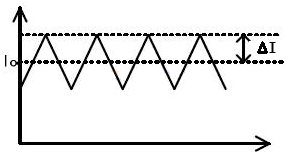
Figura 1 Corriente del inductor
La Figura 1 anterior muestra la forma de onda de la corriente dentro del inductor L de una fuente de alimentación conmutada. La corriente de rizado ΔI se puede calcular mediante la siguiente fórmula. Basándonos en el equilibrio voltio-segundo y otros parámetros, se observa que aumentar el valor del inductor L o la frecuencia de conmutación reduce la fluctuación de corriente dentro del inductor. De manera similar, la relación entre el rizado de salida y la capacitancia de salida es: Vripple = Imax/(Co × fsw). Se observa que aumentar el valor de la capacitancia de salida reduce el rizado.
Generalmente, se utilizan condensadores electrolíticos de aluminio como condensador de salida para lograr una capacitancia elevada. Sin embargo, estos condensadores no son muy eficaces para suprimir el ruido de alta frecuencia y su ESR es relativamente alta. Por lo tanto, se conecta un condensador cerámico en paralelo para compensar las limitaciones de los condensadores electrolíticos de aluminio.
Cuando una fuente de alimentación conmutada está en funcionamiento, la tensión de entrada Vin permanece constante, pero la corriente varía con el interruptor. Al encender la fuente o si la carga cambia bruscamente, se necesita un condensador de entrada como reserva de energía temporal para compensar la caída instantánea de la tensión de entrada. Normalmente, se conecta un condensador en paralelo cerca del terminal de entrada de corriente (cerca del interruptor en un convertidor Buck) para proporcionar corriente. El condensador de entrada también suprime la ondulación y la interferencia electromagnética (EMI) de la fuente de alimentación anterior.
Tras adoptar la solución anterior, la fuente de alimentación conmutada de tipo BUCK se muestra en la siguiente figura:
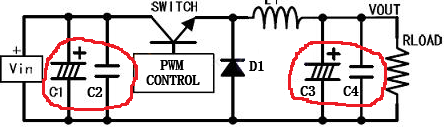 Figura 2 Topología BUCK
El método descrito anteriormente tiene un efecto limitado en la reducción de la ondulación. Debido a las limitaciones de tamaño, el inductor no puede ser muy grande; aumentar el condensador de salida hasta cierto punto no tiene un efecto significativo en la reducción de la ondulación; y aumentar la frecuencia de conmutación incrementará las pérdidas por conmutación.
Los filtros LC son eficaces para suprimir el ruido y la ondulación. Al seleccionar los inductores y condensadores adecuados para construir el circuito del filtro en función de la frecuencia de ondulación que se desea eliminar, esta se puede reducir significativamente. Sin embargo, en este caso, es necesario considerar el punto de muestreo de la tensión de comparación de retroalimentación.
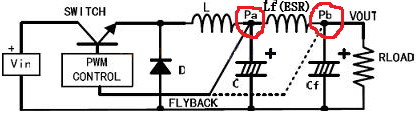 Figura 3
Seleccionar el punto de muestreo antes del filtro LC (Pa) resultará en una disminución de la tensión de salida. Esto se debe a que cualquier inductor tiene una resistencia de CC, y cuando se emite corriente, se produce una caída de tensión en el inductor, lo que provoca una disminución de la tensión de salida de la fuente de alimentación. Además, esta caída de tensión varía con la corriente de salida. Seleccionar el punto de muestreo después del filtro LC (Pb) producirá la tensión de salida deseada. Sin embargo, esto introduce un inductor y un condensador en el sistema de alimentación, lo que podría afectar la estabilidad del bucle.
La combinación más común es BUCK+LDO, que es la forma más eficaz de reducir la ondulación y el ruido. Proporciona una tensión de salida constante sin necesidad de modificar el sistema de retroalimentación original, pero esto también reduce la eficiencia general del sistema de alimentación y resulta la opción más costosa. Un parámetro clave para los LDO es el PSRR (índice de rechazo de la fuente de alimentación), que cuantifica la medida en que las variaciones en la entrada de alimentación se transmiten a la salida. Tras pasar por un LDO, la ondulación de conmutación suele ser inferior a 10 mV.

El diseño de la placa de circuito impreso (PCB) de una fuente de alimentación conmutada también es crucial para reducir la ondulación. Una colocación incorrecta de los componentes, una conexión a tierra inadecuada o la proximidad de pistas críticas a la zona sensible al interruptor pueden provocar un aumento de la ondulación y del ruido de alta frecuencia.
dejar un mensaje
Escanea y envíalo a WeChat. :