

En entornos industriales, para ahorrar en cableado, se suele utilizar un sistema de dos cables de 4-20 mA. Este sistema utiliza dos cables para alimentar simultáneamente el sensor/transmisor de campo y transmitir la señal analógica. Sabemos que el circuito sensor/transmisor requiere cierta corriente para funcionar; por lo tanto, la estructura del circuito que utiliza este método debe ser de bajo consumo. La corriente de punto cero de 4 mA garantiza que el dispositivo pueda arrancar y funcionar con normalidad. La transmisión de la señal analógica se logra ajustando dinámicamente un circuito de fuente de corriente constante para garantizar que la corriente total en el bucle se mantenga exactamente entre 4 mA y 20 mA.
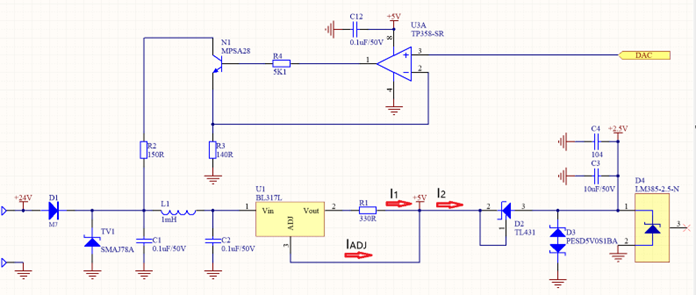
Figura 1. Circuito de regulación de corriente y voltaje constantes
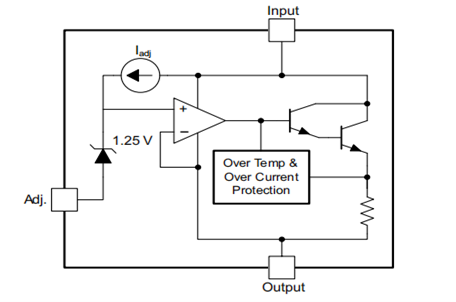
Figura 2. Diagrama de la estructura interna del LM317
La Figura 1 muestra un circuito regulador de corriente constante construido con el BL317, un circuito de fuente de corriente constante de baja potencia que controla con precisión la corriente de salida a 3,8 mA. El circuito garantiza que la corriente que fluye hacia U1 se mantenga constante a 3,8 mA, evitando que fluctúe con los cambios en la carga aguas abajo. Como se muestra en el diagrama de estructura interna del LM317 en la Figura 2, la tensión entre Vout y ADJ se mantiene estable en aproximadamente 1,25 V durante el funcionamiento normal, por lo que la corriente I1 a través de la resistencia R1 también permanece constante. La dirección de la corriente se indica mediante flechas, de las cuales se puede derivar la siguiente relación: I2 = I1 + IADJ, donde yoADJ es de 50 μA y puede despreciarse. Por lo tanto, I₂ es aproximadamente igual a I₁, es decir, I₂ ≈ I₁ = 1,25 V/330 Ω = 3,8 mA.
La siguiente etapa del circuito, que se muestra en la Figura 1, utiliza el diodo de referencia de voltaje de baja potencia LM385-2.5 para proporcionar una fuente de alimentación regulada de 2,5 V al sistema de baja potencia. El LM385-2.5 opera en un rango de corriente de 20 μA a 20 mA, presenta una impedancia dinámica extremadamente baja y una excelente estabilidad térmica. El circuito también aprovecha inteligentemente las características de la fuente de referencia de voltaje de precisión TL431, cortocircuitando el pin de referencia 1 y el pin de cátodo 2 del TL431 y conectándolos en serie con el circuito. En esta configuración, la caída de voltaje entre el ánodo y el cátodo del TL431 es de 2,5 V, lo que garantiza que el voltaje de salida en la fuente de corriente constante I2 sea de 5 V. Este voltaje puede alimentar el circuito de acondicionamiento de señal.
dejar un mensaje
Escanea y envíalo a WeChat. :